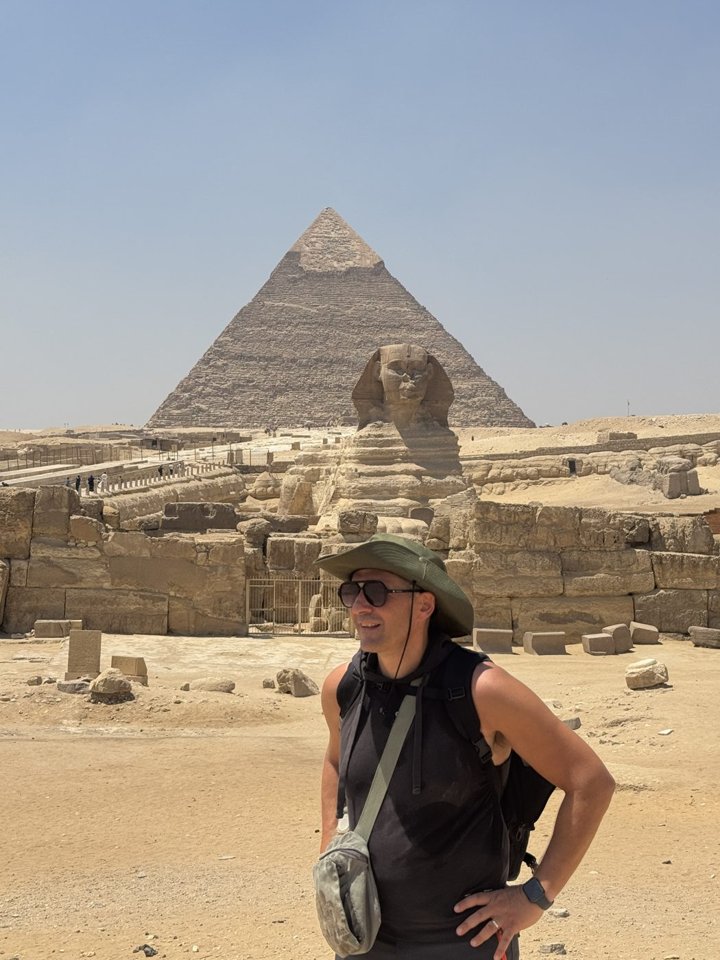
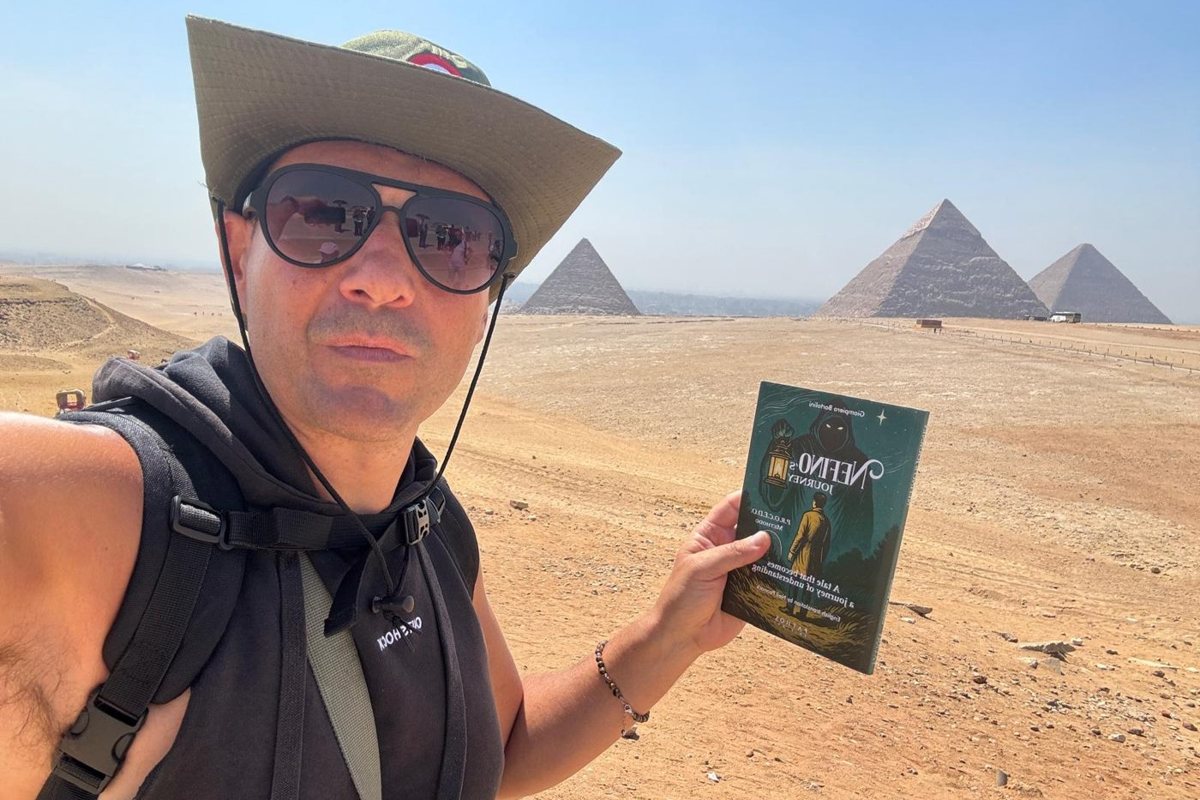
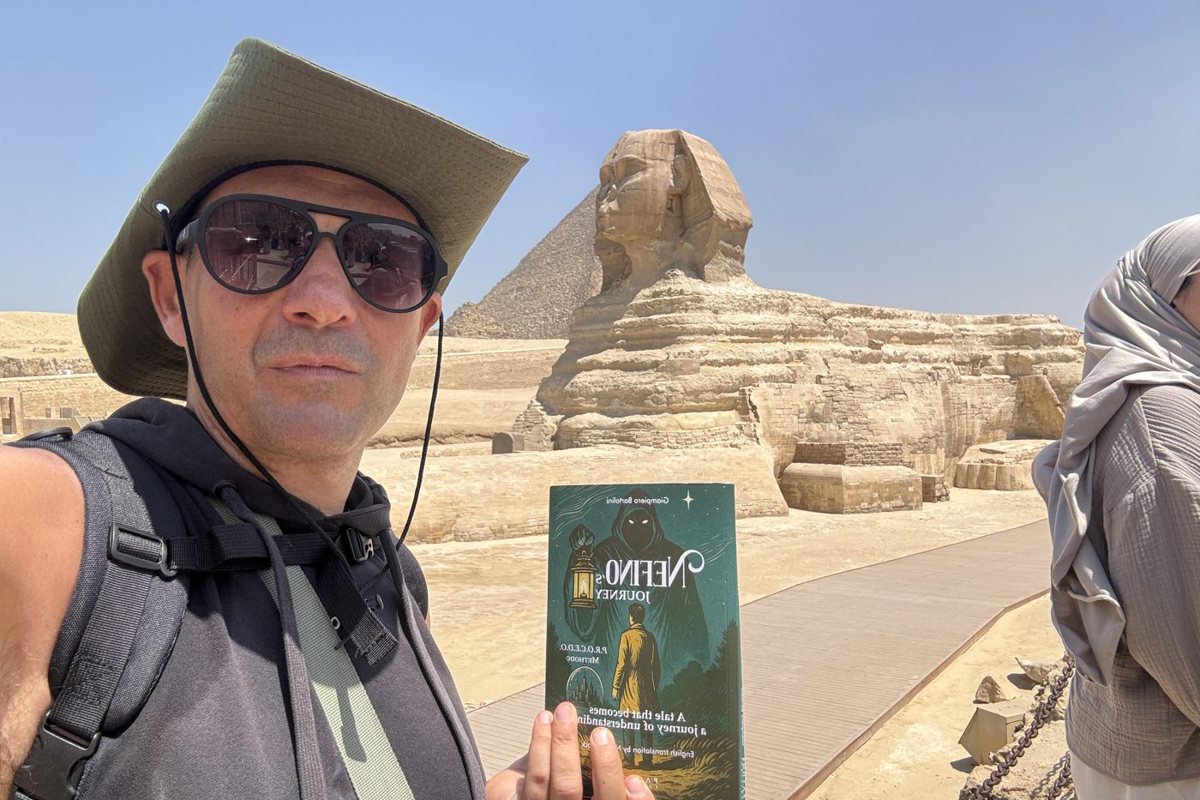
In August I left for Egypt with the book in my suitcase. I wanted to photograph it in front of the pyramids, I admit it. But I came back with something no camera can capture.
A name I already knew
In the book, the Khaib is the device that filters reality for the people of Nefino’s planet. I didn’t invent that name out of nothing: it comes from the ancient Egyptian khaibit, the shadow, one of the parts of the soul for the ancient Egyptians.
At Giza our guide was Walid Elshaer. I told him about the book and he stopped, surprised: in Egyptian Arabic today, he explained, khabeit still means something hidden. Then he told me what his own name means: the newborn poet.
The Khaib is not just a screen in front of our eyes. It is also what we hide from ourselves.
I felt a circle close, one that had opened years earlier in front of a blank page.
Inside Menkaure, alone
The Pyramid of Menkaure is the smallest of the three great pyramids of Giza, and perhaps for that reason the least crowded. You go down a narrow, sloping passage, bent forward, the air growing stiller with every step, until you reach the burial chamber. The sarcophagus is gone: in the nineteenth century it was loaded onto a ship bound for England, which sank. It lies at the bottom of the sea.
That day, by a coincidence that still surprises me, there was nobody inside. Just me, the stone and the silence.
I sat down and closed my eyes. I did what I suggest in my workshops: feel your feet on the ground, feel your breath, and tell yourself “I am here”. After a few minutes I began to sense a vibration. I don’t want to explain it in technical terms: it was a deep, physical sensation, as if my body were resonating with the space around it. My thoughts grew sparse, until they almost disappeared.
I don’t know how long I stayed there. I know that when I climbed back into the light, something had changed in the way I was looking.
The Serapeum: giants beneath the sand
The other place I carry with me is the Serapeum at Saqqara. You go underground into long galleries cut into the rock, and on either side open niches holding enormous granite boxes, some weighing tens of tonnes, worked with a precision that leaves you speechless. They were made for the sacred Apis bulls.
I laid my hands on one of those polished surfaces: smooth, cold, perfect. And there I understood something I had only ever read about. That place is not just matter.
The stones speak. Not in words, but with a presence you feel in your body before you feel it in your head.
You can know the measurements, the dates, the scholars’ theories. But when you are there, with your hands on the stone, knowledge takes second place. What remains is the experience.
What I bring home
I have often wondered why some places move us so much. I think it is because they make us stop. In front of something so vast and so old, our inner chatter loses its importance, and for a moment we are simply present.
It is the same gesture Nefino makes when he takes off his Khaib and sees the real sky. You don’t need to go to Egypt to do it. But sometimes you need a place that reminds you how.
This week, find a place that means something to you: an empty church, a wood, an old stone, even a room at home. Sit in silence for five minutes with your hands resting on something solid, and listen to what you feel in your body before you start thinking.
Share this article
If it made you think, it might make someone else think too.
Want to read the next article?
Leave your details and I’ll let you know when it’s out. Or experience the Method in a workshop.